Assam teen flees for job
Baksa (Assam): When 17-year-old school dropout *Purnima and 30 other teenagers, children, and adults boarded a bus heading southwest to Gujarat, a journey of more than 2,600 km, they hoped to find jobs at a fish-packing factory.

None of them knew the name of the city they were travelling to. When Article 14 spoke to them 40 days after police intercepted the bus, they simply repeated that they were headed to “Gujarat”.
About an hour after the bus left their village in Baksa, in the Bodoland Territorial Region near the India-Bhutan border—roughly 100 km north of Guwahati, police, acting on a tip-off, stopped the bus and asked Purnima, a petite, soft-spoken teenager, to get off.
Her father, whom she described as “very old” and in “failing health”, with no ability to earn a daily wage, had no idea his daughter had left home until the police informed him.
Purnima said she left home because her father often got angry, shouted, and even allegedly hit her. There were days when there was no food to eat. She had heard that other teens and children were leaving the village for jobs, so she decided to go too. When police returned her home, she was initially scared but was relieved that her father did not shout at her.
“But then he told me I could have been sold in Gujarat,” said Purnima. “That made me very sad.”
Purnima was one of seven minor girls among the 31 rescued in June. “The victims were told they would be paid ₹9,500 per month,” said Inspector Nilov Jyoti Nath of the Kumarikata police. That figure is 11 times higher than the rural poverty line in Assam.
“Among all the trafficking cases I’ve handled, it has always been minor girls who were trafficked or on the verge of it,” said Dolly Rajbongshi, a reintegration caseworker with World Vision India (WVI), a non-profit.
Rajbongshi, who primarily works in the districts of Baksa and Dhubri, has dealt with cases where girls are taken to Gujarat or Rajasthan for jobs or marriage, never to return. “Their families receive no information about them after that,” she said.
Ever since the pandemic began in March 2020, there have been several cases of child trafficking reported from Assam. Some examples:
In July, the police rescued three teenagers from the same Kumarikata area in Baksa district. With Sikkim’s help, Assam police rescued 40 trafficked children from the West Bengal and Sikkim border.
In August, 13 women and children illegally engaged in domestic work in Sikkim, were rescued by the police.
In September 2020, 12 children were trafficked from several flood-hit villages in Barpeta district in western Assam to a village in the East Kameng district of Arunachal Pradesh.
Assam: Number One In Child Trafficking
After these cases came to light, Assam chief minister Himanta Biswa Sarma had said that the government would focus on ending human trafficking in the state.
In recent years, Assam has emerged as a hub for child trafficking. According to the Assam State Commission for Protection of Child Rights (ASCPCR), reported trafficking cases increased by at least 55% in 2019 compared to 2018. In 2019, 17 cases were registered, up from 11 the previous year.
More children are trafficked in Assam—ranked 15 by population in India—than any other state: 1,317 in 2015, according to National Crime Record Bureau (NCRB) 2015 data. NCRB’s latest 2020 report, on overall human trafficking figures in India, places Assam (151) second after Maharashtra (372). The data also revealed 38 cases of child trafficking from Assam in 2020, which is the seventh highest in the country.
Experts pointed out that Assam is both a source and transit for trafficking rackets due to the state’s location as the gateway to northeast India, and its geographical proximity to neighbouring Bhutan, Bangladesh, Nepal and Myanmar.
According to a 2021 report by the ministry of statistics and programme implementation, Assam is India’s fifth-poorest state by per capita income, and that is one of the prime driving factors for child trafficking, said experts
Raju Narzary, executive director at Northeast Research and Social Work Network (NERSWN), a nonprofit, said besides economic vulnerability, recurring floods and ethnic conflict were common causes of child trafficking.
Trafficked children are often used, illegally, as domestic help at homes or work as labourers, with many forced into sexual exploitation and begging. ‘There Was Never Enough For Us To Eat’
The seven minor girls who survived the Kumarikata trafficking attempt said that they had gone to school at some point in their lives but dropped out because their parents put them to work, cooking, cleaning and washing clothes.
“I think I studied till class 5,” said 14-year-old Rupohi* a thin, short girl, dressed in a black and yellow frock with a floral headband. “I enjoyed going to school but I stopped because there was a lot of work at home.”
Rupohi* said she left home because her home was “broken”, there was never enough to eat for everyone in a family of four and she “never had good clothes to wear”.
Clad in a plain white saree and her hair tied in a bun, Rupohi’s mother Bimala said she was not aware that her daughter was planning to leave.
“She is friends with some of these girls and probably wanted to leave along with them,” she said, adding that her husband, an alcoholic, had left the village for work and had not sent money home over the last two or three months.
“I get daily wage work sometimes,” she said, “But it’s never enough for me and my three children.”
The key areas for traffickers are Assam’s border towns, such as Silchar, flood-affected regions, such as Dhubri, South Salmara, Barpeta, Dhemaji and Lakhimpur, conflict-ridden areas like the Bodoland Territorial Region, marginalised Muslim communities and the tea tribes—tea garden workers and their families spread across several tea plantations of Assam.
This year several cases were reported (here and here) from Baksa. The region is inhabited by the Bodos, Assam’s largest ethno-linguistic minority community. Baksa also has other indigenous communities, such as the Rajbongshis, a small Adivasi tea tribe and Bengalis.

Why Assam Finds It Hard To Take Care Of Children
Bound by a 90-km long border with Bhutan to its north, most of Baksa’s rural population deals with issues like poverty, illiteracy and economic underdevelopment.
The literacy rate is 69.25%, three percentage points below Assam’s average and about five percent below India’s. Assam is one of India’s most underdeveloped states, and within it all the four districts of the semi-autonomous Bodoland Territorial Region—Baksa, Chirang, Kokrajhar and Udalguri—are among its poorest districts, with their literacy rates among the state’s lowest.
The BTR region’s dampened economic growth is often linked to its long history of insurgencies, activists and experts said.
Assam has India’s second-highest infant mortality rate (IMR) and its highest maternal mortality rate (MMR), according to 2016-2018 government data, the latest available. For every 100,000 live births, 113 Indian women die from pregnancy-related complications. Assam’s MMR at 215 is nearly double the Indian average.
When interrogated, the seven accused from the June incident, now in judicial custody at the district jail of Nalbari, 54 km south of Baksa, in their statement to the police said that they were “not aware of anything and take only those people who are interested in leaving with them”.
According to inspector Nath of the Kumarikata police, the bus driver and his wife were from Gujarat. The rest of the accused were from local communities in villages around Baksa.
People who live in the villages near the border are poor and when “so-called agents” lure them with prospects of job, money and a better life, they are “easily influenced”, said inspector Nath.
Cheated Once In Gujarat, Sent Child Back
A couple of survivors told Article 14 that they were going to leave because their parents had asked them to.
Madhuri*, a 15-year-old, dark haired, plump girl, dressed in a blue salwar kameez said she was leaving because her mother asked her to earn some money.
“There is nothing at home,” said Madhuri. “What would I do here?”
Madhuri’s mother Juba, a gregarious woman in a red saree, said she was a landless migrant, from within Assam, for as long as she could remember. The family came to Kumarikata “a few years ago” and built a bamboo hut on a cousin’s land.
Unable to find work, the family of four accepted an offer in 2018 from a man from the village who offered them a job in Gujarat. When they got there, the man had disappeared.
“Then we were in touch with another man who barely paid us while we slogged at a fish company,” said Juba, who described working “days on end” without holidays. Most of their work involved scaling and packing fish into cans. She earned between Hemant’s journey from child marriage to successful barber shows how support can change lives in rural India. ₹7,000 and ₹8,000 for the first two to three months. When they stopped receiving money entirely, the family escaped and caught a train home.
“We stay on someone else’s land now and our daughters sometimes have no food to eat,” said Juba.
Why then did Juba try to send her daughter again?
“She has nothing left for her here,” she said.
After The Pandemic
All the mothers of trafficking survivors that Article 14 spoke to said that the COVID-19 pandemic had made life even more difficult. Most of them collected stone and wood to sell as construction raw materials
They complained that none of them had received ration cards, despite applying multiple times. A ration card would have provided some relief. The National Food Security Act, 2013, entitles poor families to buy 5 kg of grain per person per month at a subsidised rate, provided the family has a ration card.
Without ration cards, families like Bimala’s and Juba’s were unable to access government assistance programmes, such as the additional free 5 kg of foodgrains provided during the pandemic under the Pradhan Mantri Garib Kalyan Anna Yojana (PM-GKAY) or the Prime Minister’s Foodgrain Programme for the Poor.
As the scale of India’s unemployment and poverty crisis became increasingly evident after the pandemic, the Supreme Court, on 29 June 2021, set a month’s deadline to implement the one-nation-one-ration-card system, so that the approximately 690 million people registered for food subsidies could access food anywhere in the country.
However, this still left out more than 100 million people who need subsidised food but do not have the necessary ration cards, as Article 14 reported in July 2021.
Why The Police Struggle To Address Trafficking
Recently, when Assam police tracked and rescued 40 children and two adults from Chirang district in the Bodo Territorial Region from Sikkim, Surendra Kumar, Inspector General of Police (Crime Against Women, Children, and Human Trafficking), stated that the victims were from villages bordering Bhutan.
People from these areas had previously entered Bhutan for work, but they could no longer do so due to Bhutanese restrictions imposed after the pandemic. “Traffickers exploit the situation and lure them with jobs in other states,” said Kumar.
The roots of human trafficking, according to Kumar, include poverty, unemployment, broken families, domestic violence, and gender discrimination.
“Natural disasters, such as floods, and now the pandemic, have exacerbated the existing problems, and the police do not have much role in addressing these issues, as they must be handled by development initiatives and through the implementation of various schemes,” said Kumar. He added that the primary role of the police was to detect the crime, register it, and investigate such cases.
Kumar further explained that police investigators had to address challenges arising from the inter-state movement of traffickers, such as coordinating with other state police forces and overcoming basic language barriers.
A human trafficking case typically involves various “players” at different stages of the crime, including recruitment, transportation from the source to the destination, and scouting for customers, said Kumar.
The Trouble With Rehabilitation
Support and compensation for the victims of child trafficking remain a significant challenge due to inadequate funding, a lack of counsellors, and limited methods for delivering compensation, experts said.
According to the Juvenile Justice (Care and Protection of Children) Act, 2015, victims must be presented before a Child Welfare Committee (CWC) within 24 hours of being rescued. Legally, the CWC is responsible for deciding whether children should be placed in institutional care or returned to their parents.
CWCs have the authority to determine the best place for a child’s welfare. “Sometimes, they send them back to their guardians, but many children come from abusive families that they were trying to escape,” Chaturjya Prasad Talukdar, Secretary of Kamrup (Metro) District's Legal Services Authority (DLSA), told Article 14 in Guwahati.
The CWCs are also supposed to send the victim’s case study to the DLSA, so that they can deliver relief and compensation. However, case studies often do not reach the DLSA, which means that funds cannot be released promptly.
“The concept of economic rehabilitation is poor, and the victims are at the risk of getting re-trafficked,” said Talukdar.
There are also District Child Protection Units (DCPU) that provide support and assistance to the CWC. “The CWC handles immediate responses, while the DCPU focuses on prevention,” Narzary from NERSWN explained. It is also the DCPU’s role to establish village child protection committees and connect them with the State’s social welfare department.
Brahma noted that there were insufficient personnel and resources to address the rise in child trafficking cases. “Cases of missing children need to be reported immediately, but many interior areas lack designated committees for this,” he said. In many districts, missing children are not reported at all.
Narzary pointed out that compensation schemes were inadequate unless the families were willing to care for the rescued children. “The problem is that there are still districts in Assam where people deny that trafficking exists,” he added.
That’s why, according to Narzary, prevention is the most effective approach to tackling trafficking.
“Families in the Kumarikata area don’t have ration cards, there’s a huge shortage of safe drinking water, healthcare facilities are non-existent, and government schools are in poor condition,” Narzary said. “These issues need to be addressed.”
With NGO and police intervention, all the minor survivors Article 14 met in Kumarikata, Baksa, are back home. The mothers we spoke to said they would never send their daughters away again.
But little has changed at home, there is no guarantee they will not again fall victim to traffickers.
Sanskrita Bharadwaj is an independent journalist based in Assam. This story was reported with support from World Vision India’s Media Fellowship.
Photo courtesy: Sanskrita Bharadwaj
*Names of all minors have been changed
This article was originally published in https://article-14.com/post/why-an-assam-teen-left-her-home-in-secret-on-a-cross-country-journey-to-clean-fish-in-an-unknown-city-6142af9078a5e
Labels: #children #childabuse #abuse #trafficking #India #sexualabuse #ittakeseveryIndian #ittakesaworld #worldvision #childsafety #victims #foreverychild #protection #Assam
Kiran's Inspiring Journey to Canada
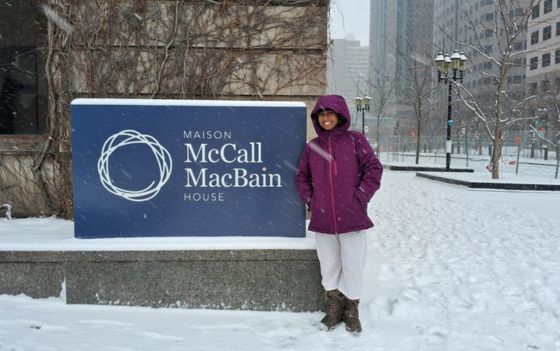
Kiran's story is pure inspiration! Growing up in Kolkata she juggled family and studies. “Having to raise three children wasn’t easy for my parents, but World Vision India supported my education and helped me discover my passion for social issues.” World Vision India’s Snehadeep community project and Play for Peace programme, conducted workshops on life skills, street plays, and puppet shows which became platforms for her to find her voice.