Building resilient communities
Half a dozen people are gathered under a banyan tree, which offers very little shade: its branches have snapped, and its leaves have been blown away. This is just a week after Cyclone Fani, and it’s Anitha Sadasivan’s first day of deployment. Sitting there, effortlessly chatting with those who have come to collect relief materials, she is one among them.

Odisha was reeling from the devastation and loss caused by Cyclone Fani. Power cuts were frequent, and the heatwave was beginning to intensify. But Anitha had learned to overlook these discomforts and focus on the needs of the community.
“Whenever there is a disaster, I pack my bag and keep it ready, waiting for the call to deploy. When the call came, I replied, ‘I’m ready, even today,” says Anitha about her latest deployment. Her years of experience in such situations have made her feel at home here.
At a Child Friendly Space (CFS) centre set up by World Vision India after Cyclone Fani, Anitha seamlessly blends in with around fifty children. She has the heart and enthusiasm of a child herself and enjoys every activity, be it playing games or singing.
Anitha’s first experience with humanitarian response came in 2013 when she became part of World Vision India’s National Rapid Response Team (NRRT). Her first deployment was during the Bardhaman floods in 2016. The response team was accommodated in a small house in the midst of the flooded landscape; they had to travel by boat or sometimes wade through water to reach affected villages. The devastation and suffering she witnessed still linger in her memories. But she doesn’t recall her own struggles for food, clean water, or clothes
During one of her assessment visits in flood-affected areas of Bardhaman, Anitha met Chandan Dasi, an elderly woman who had lost everything in the floods. This encounter stayed with her, shaping her personal view on humanitarian work. The two could not communicate as Chandan spoke only Bengali, which Anitha didn’t understand. Yet, they formed a silent bond based on empathy.
“She smiled the entire time, despite losing everything. She tapped her chest and kept saying, “Main amma, I’m like your mother.” She and the villagers gave me so much love,” Anitha reminisces, a sense of nostalgia in her voice.

World Vision India responded and went on to build transition shelters for affected families in Chandan Dasi’s community. Long after Anitha had returned home, Chandan Dasi kept inquiring about her well-being. To Anitha, these memories are like trophies she carries with her proof of her service. The ability to bring smiles to people’s faces, simply by showing that she cares, is what humanitarian work means to her.
When asked about her biggest challenge, Anitha speaks without hesitation, “Language is the biggest barrier anywhere, but the relationship of hearts can overcome that. When the language barrier is larger, the bond of hearts becomes stronger.”
As the only female staff member, a common scenario in humanitarian responses, she hasn’t let gender barriers hinder her work. Anitha is a mother of two, and her children have always been supportive of her work, even when she must be away from home for weeks. She believes she has trained them well to be self-reliant.
Anitha joined World Vision India in 1998 and soon found a deep sense of fulfilment. Her readiness and dedication to service have never been in question, and she was rewarded with the Best Community Development Facilitator (CDF) award.
Her life has been filled with hardships, but these challenges have shaped her indomitable will and resilience. The beautiful backwaters of Alappuzha, where she was born and raised, stand in contrast to her impoverished childhood. While her father was determined to keep all his four daughters in school, Anitha knew this would be a struggle beyond his means. Unable to afford private schools, they attended government schools.
“I knew it was too difficult for my father to take care of all of us, so I told him to focus on my sisters. I was determined to take care of myself. I gave coaching to younger students and managed to complete my 10th exam. After passing the 12th, I got married at the age of 19,” she reflects.
“There was a time when I almost died. I had heart problems, but many people prayed for me, and I was completely healed. I believe in a higher power, a master who sees everything. So I try to live in obedience and service to that master,” Anitha reflects.
Currently based in Gurgaon, Anitha has spent many nights in a rented community hall, with few or no basic amenities. She has no qualms about sleeping on the hard concrete floor.
“She spends more time with us than at home,” says Bajrang, 18, from the community with a smile. Bajrang first met Anitha when he was just eight years old. Today, he is pursuing a Bachelor of Science with Physics honours and is a master trainer in LSET (Life Skill Education for Transformation), Article 15, and ECAP (Empowering Children as Peacebuilders). The community is full of such individuals and testimonies.
“She is like a sister, a mother, a daughter,” said Nisha, 34, a member of the Child Protection Unit.
Anitha’s driving force is to strengthen local capacities, empowering communities to respond to disasters and advocate for their rights.
“Communities are the first responders in every situation. Keeping them ready and well trained will save their lives.”
“I don’t want to keep everything in my head. I want to pass on as much knowledge as I can. I won’t be in their community forever, so I want them to be able to stand on their own when we’re gone. This has always been my personal motto for work,” Anitha stresses.

Whether it’s raising strong individuals empowered with knowledge or building communities fully aware of their rights and ready to advocate for them, Anitha’s dream of creating self-reliant communities is becoming a reality.
At the CFS, children pour their hearts out onto paper. The painting exercise is a therapeutic process, helping them come to terms with the devastation of Cyclone Fani. The room has no electricity, and Anitha sweats profusely as she supervises the children. Sultana, 13, paints houses with no roofs and fallen trees. The painting looks grim, but Sultana’s positive outlook impresses Anitha.
“What touches me is her positive outlook on life. Despite all the loss, Sultana said they learned so much and will be better prepared in life. At her age, I was only concerned about my family, but she is already thinking about the community,” Anitha says, excited about Sultana’s future. Anitha sees a glimpse of her younger self in Sultana.
Anitha doesn’t speak Odia like the locals, but she finds ways to communicate. Her experience in such situations has made her believe that everything can be done with a strong will.
Labels: #aidworker #Andhra #bardhaman #betterworld #staff #children #whd2019 #Worldhumanitarianday #worldvisionindia #worldvision
Kiran's Inspiring Journey to Canada
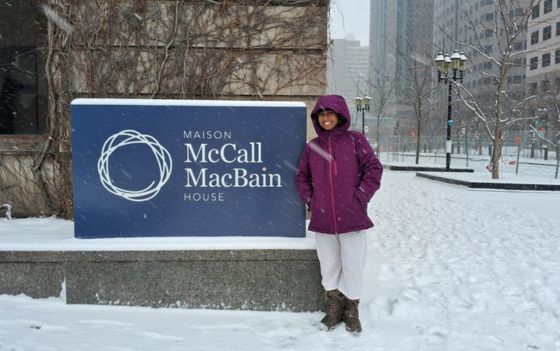
Kiran's story is pure inspiration! Growing up in Kolkata she juggled family and studies. “Having to raise three children wasn’t easy for my parents, but World Vision India supported my education and helped me discover my passion for social issues.” World Vision India’s Snehadeep community project and Play for Peace programme, conducted workshops on life skills, street plays, and puppet shows which became platforms for her to find her voice.