A hope-giving home
“Through the support of World Vision, my leg has been corrected. I can walk freely now without any support,” says Saranya happily.
In the 1980s, a town in Madurai District of Tamil Nadu called Melur, along with its surrounding villages, was identified by health authorities as having a large number of children affected by polio. Even after intensified polio eradication programmes by the government, the rural population near Melur failed to utilise these facilities owing to cultural practices and fears.
In 1991, World Vision India began supporting the Clara Olive Polio Home project to assist the Government in eradicating polio and to provide care and support to children already affected in the area. The home extended its support to girl children from OCPM Girls Higher Secondary School and also to children with intellectual disabilities from Pasumalai and Rameshwaram. There were 144 children (98 boys and 46 girls) benefiting from this programme at the time.
The project focused on education and health care. It is aimed at assisting the children to pay their various fees and enjoy programmes that support them with notebooks, textbooks uniform, clothing and other essentials. The project also provides proper healthcare for the children, which has brought about a tremendous improvement in the lives of children with disabilities. Over 500 children with disabilities were provided with better access to education and a happy childhood through World Vision India’s programmes.
Through to the polio eradication programme of the Government of India and World Vision’s awareness initiatives, polio was completely eradicated from the target areas. Many of the children who had been affected by polio were now well settled and leading successful lives. Over the years, hundreds of success stories from the children served testified to how their lives had been transformed because of the project. Many of their families had not been able to afford to support their education or provide assistive devices or corrective surgeries.
At the home, all children were ensured good health, nutritious food, and a hygienic atmosphere in the hostel to grow in a healthy environment. Regular health check-ups were organised, and corrective surgeries were arranged for children in need.

Saranya’s story
Saranya was from a small village near Madurai, Tamil Nadu. She had been affected by polio at the age of three and lost both her parents at a very young age. She studied at a local school for a few years and, when she was in Class VII, due to her condition, she was admitted to the Clara Olive Hostel in Melur. She used to walk with the help of a stick. However, through medical assistance from World Vision India, Saranya underwent corrective surgery. Her left leg was corrected, and now both her legs were normal. She was able to walk without the need for any support. Saranya was then studying in Class X.
Some of the children supported by the project excelled academically and have since become sponsors themselves through World Vision India. The project has been responsible for producing lawyers, medical workers, lecturers, and social workers, who serve as agents of inspiration and change in society.

Educational Assistance Provided
Murugesan, from the Clara Olive Polio Home, completed his Ph.D. in Tamil. He was able to finish his studies with the help of World Vision India. He is now working as an Assistant Professor.
“I am thankful to World Vision India for providing me with educational assistance. Now I receive a good salary, and I proudly share my experience with my friends and colleagues about the care, protection, and help I received from World Vision,” says Murugesan.
Most of the children living in the Clara Olive Polio Home came from families who earned their living by working as daily wage labourers—mainly as porters, washermen, sanitation workers, masons, load men, and labourers in construction work. Economic development initiatives helped the very poorest families to engage in alternative or diversified sources of income. The skill and entrepreneurial training programme under the Economic Development sector assisted many families in planning better and implementing income-generation programmes.
The existence of an inferiority complex was a major problem in the lives of children affected by polio. The children were constantly afraid to face society. They also lacked proper financial support from their families to continue their studies, especially higher education. Parents were unable to afford sending their children to school due to financial constraints. The need to arrange proper transportation for the children to attend school was a significant concern for the parents, often causing them to deprive their children of education.
In response, World Vision India provided a hostel facility for the children, which took care of all their basic needs. Disabled-friendly infrastructure was built, and the children were able to live dignified lives; this gave them the confidence to study well and pursue higher education despite their physical limitations and family backgrounds. Transportation facilities and educational assistance were provided to all children, ensuring regular school attendance.

Kannan’s story
Kannan was one such child who received accommodation and educational assistance from the Clara Olive Polio Home. He later lived with his parents and three siblings in Madurai. Unfortunately, he was born with a clubfoot. His father had been ill for several years and was bedridden, which caused the family considerable financial difficulty.
Kannan studied up to Class VIII at a local school. He wished to continue his education, but his family was unable to support him. He had always dreamt of becoming a lawyer. Through a friend, he came to know about the Clara Olive Polio Home, supported by World Vision India. He joined the hostel and resumed his studies at a school in Madurai.
After completing Class XII, Kannan aspired to pursue a Bachelor's degree in Law. However, many people in his village discouraged him, claiming it would not be possible. Nevertheless, with the financial assistance and encouragement he received from World Vision India, he enrolled in a Law college in Madurai. He successfully completed his degree and began practising under a leading law firm.
“When I start earning money, I am determined to help people like me, and I hope to run a hostel for children with disabilities,” said Kannan.
Child rights training and awareness campaigns had a significant impact in the project areas, bringing about a dramatic shift in attitudes towards children’s rights. Children, families, and communities became well informed about child rights and how to address cases of abuse. As a result, there was a notable reduction in incidents of domestic violence and violations of children’s rights.
Labels: #claraolivepoliohome #disability #worldvision #worldvisionindia #education #project #hostel #polio #poliohome
Kiran's Inspiring Journey to Canada
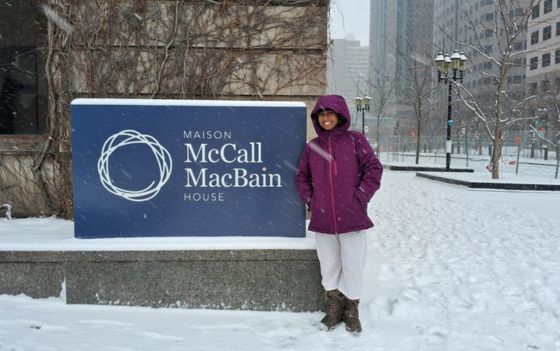
Kiran's story is pure inspiration! Growing up in Kolkata she juggled family and studies. “Having to raise three children wasn’t easy for my parents, but World Vision India supported my education and helped me discover my passion for social issues.” World Vision India’s Snehadeep community project and Play for Peace programme, conducted workshops on life skills, street plays, and puppet shows which became platforms for her to find her voice.