Keeping Girls in School: How Safe Sanitation and WASH Facilities Transform Education
For many children, going to school means carrying books, attending lessons and spending time with friends.
For thousands of adolescent girls in rural India, it can depend on something far more basic: having access to a safe, private toilet.
Across many parts of the country, inadequate water, sanitation and hygiene (WASH) facilities continue to be a significant barrier to education. A lack of separate toilets, clean water and menstrual hygiene support often makes it difficult for girls to attend school regularly. Some miss classes during menstruation. Others gradually disengage from learning altogether.
The challenge is not a lack of ambition.
It is the absence of facilities that allow girls to learn with dignity and confidence.
Recognising this need, World Vision India launched the Rise Up! Daughters of India (RUDI) project in Faridkot, Punjab, with a simple but powerful goal: create school environments where every child, especially every girl, can stay in school and thrive.
When Basic Facilities Become Barriers
For adolescents, school is about much more than academics. It is a place where friendships are formed, confidence is built and future aspirations begin to take shape.
Yet something as fundamental as sanitation can determine whether a child remains in school.
In many government schools, inadequate WASH facilities present daily challenges. Toilets may be insufficient, lack privacy or be unsuitable for girls managing menstruation. Handwashing facilities may be limited, and children with disabilities often face additional barriers due to inaccessible infrastructure.
For girls entering adolescence, these challenges can become overwhelming.
Many begin missing classes during their menstrual cycles because they do not have access to safe and private sanitation facilities. Repeated absences affect learning and confidence. Over time, some girls fall behind academically and eventually leave school altogether.
The consequences extend beyond education.
Every year of schooling contributes to better health outcomes, increased opportunities and greater confidence. Keeping girls in school is closely linked to their long-term wellbeing and the wellbeing of their communities.
Creating inclusive and functional sanitation facilities is therefore not simply an infrastructure project. It is an investment in child development and gender equality.
Building Schools That Support Every Child
Through the RUDI project, World Vision India partnered with schools and communities in Faridkot to improve water, sanitation and hygiene infrastructure.
The interventions were practical and designed around children's everyday needs.
The project established separate toilet blocks for boys and girls, ensuring privacy and dignity. Handwashing stations were installed to encourage healthy hygiene practices and reduce the spread of illnesses. Incinerators were provided to support menstrual hygiene management, and disabled-friendly units were built to make schools more accessible for children with different needs.
Alongside the physical improvements, the project also conducted awareness sessions on menstrual hygiene.
These conversations helped break long-standing taboos and created opportunities for students, teachers and communities to understand menstruation as a natural part of life rather than something surrounded by shame or silence.
The changes may appear simple.
But for many students, they transformed the experience of attending school.
Girls who once worried about managing their menstrual health at school found greater confidence. Students gained access to cleaner and safer facilities. Schools became spaces where children could focus more fully on learning.
Education Outcomes That Tell a Powerful Story
The impact of improved WASH facilities was visible not only in daily routines but also in educational outcomes.
The evaluation of the RUDI project revealed remarkable improvements in school completion rates.
At the primary level, school completion rates increased by an average of 34.4 percentage points. This indicated that significantly more children were staying in school and successfully completing their primary education.
The improvements for girls were particularly encouraging.
Primary school completion among girls increased from 58.7 per cent to 97.4 per cent, representing an improvement of 38.7 percentage points.
At the secondary level, school completion improved by 26.1 percentage points overall. Among girls, completion rates increased from 19.2 per cent to 51.6 per cent.
Behind every percentage point is a child who remained connected to education.
It is a girl attending classes consistently because she now has access to a private toilet.
It is a student feeling more confident about coming to school each day.
It is a family seeing education as a realistic and achievable pathway for their daughter.
The results demonstrate how addressing practical barriers can lead to sustainable change that extends far beyond infrastructure.
Creating Community Impact through Partnership
The lessons from Faridkot have been reinforced through other initiatives as well.
Through the Support My School campaign, implemented in partnership with the Coca-Cola Foundation, World Vision India constructed more than 250 separate toilets across schools.
These facilities have benefited over 15,000 students.
The numbers reflect something deeply important: when schools provide safe and inclusive environments, children are more likely to remain engaged in learning.
Investments in water, sanitation and hygiene do more than improve school buildings.
They contribute to healthier behaviours, greater dignity and stronger educational outcomes. They support child development by ensuring that practical challenges do not become barriers to learning.
Most importantly, they send a powerful message to every child, especially every girl: your education matters.
A Future Where Every Girl Can Learn
The journey towards educational equity often begins with meeting basic needs.
A classroom can inspire learning, but children also need clean water, safe sanitation and supportive environments that recognise their everyday realities.
For adolescent girls, access to private and functional sanitation facilities can mean the difference between staying in school and falling behind.
In Faridkot, improved WASH facilities have helped create schools where girls can attend classes with confidence and continue pursuing their education.
Their stories remind us that meaningful change is often built through practical solutions that uphold dignity and remove barriers.
Sometimes, keeping a girl in school begins with something as simple as opening the door to a clean, safe toilet.
And behind that door lies the opportunity for her to keep learning, keep growing and keep imagining a future full of possibilities.
Kiran's Inspiring Journey to Canada
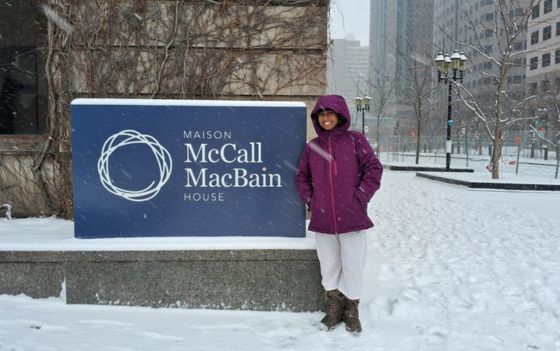
Kiran's story is pure inspiration! Growing up in Kolkata she juggled family and studies. “Having to raise three children wasn’t easy for my parents, but World Vision India supported my education and helped me discover my passion for social issues.” World Vision India’s Snehadeep community project and Play for Peace programme, conducted workshops on life skills, street plays, and puppet shows which became platforms for her to find her voice.