How NGO Livelihood Support Helps Families Build Food Security and Resilience
When a crisis enters a household, it rarely stops at the loss of a job.
It reaches the kitchen.
It changes what a family can afford to put on the table, whether a child gets a nutritious meal, whether a parent can pay the next bill, and how long a family can keep going without borrowing.
During the COVID-19 pandemic, millions of families across India experienced this uncertainty. The State of Working India 2021 report by Azim Premji University found that the number of people below the national minimum wage threshold increased by 230 million during the pandemic. Income poverty rose by 15 percentage points in rural India and nearly 20 percentage points in urban India.
For families already living on very little, the crisis was not simply about losing employment.
It was about survival.
At the grassroots, World Vision India heard the same concerns repeatedly: families needed food to eat, an income to rely on and a way to get through uncertainty without compromising their children's wellbeing. This is where the work of impact-driven NGOs becomes particularly important. By combining immediate assistance with longer-term livelihood support, communities can be helped to recover with dignity and resilience.
When the Sea Could No Longer Provide
In Poonthura, a coastal fishing village in Kerala, the sea has long been at the heart of everyday life. Around 90 per cent of residents depend on fishing and related livelihoods for their income.
For young Vyga and her family, the sea was their source of livelihood too.
Then Cyclone Ockhi struck in 2017.
The cyclone caused widespread disruption along Kerala's coast, affecting fishing communities whose incomes depended directly on the sea. For Vyga's family, the impact lasted well beyond the storm itself. Her father stopped fishing, and without his earnings, the family's financial situation became increasingly difficult.
They also had a small petty shop to run.
But without enough money to purchase stock, keeping the shop open became another challenge.
The family found themselves struggling to meet even their most basic needs. A business that could have provided an income had effectively come to a standstill because they did not have the money to restart it.
This is how crises can deepen.
A family loses its primary income. The small business that could help them recover also lacks the capital to reopen. Savings disappear. Food becomes harder to afford. Every decision begins to revolve around what can be postponed and what cannot.
For Vyga's family, support arrived in the form of a direct cash transfer of ₹5,000 from World Vision India.
It was not an enormous sum.
But it was enough to give the family something they urgently needed: a way to begin again.
Turning Support into an Income
Vyga's parents used the money to restock their petty shop.
The shutters could open again. Products could return to the shelves. Customers could come back.
Slowly, the shop began generating an income that the family could use towards their essential needs.
“With World Vision India timely support, we have been fortunate to earn money to meet our family's essential needs,” Vyga said.
There is something important in those words.
The support did not simply provide temporary relief. It helped the family restore a source of income they could manage themselves.
For a family facing uncertainty, having that choice matters.
It means being able to decide what the household needs most. It means having an opportunity to rebuild rather than remaining dependent on emergency assistance.
And when a family's livelihood becomes more stable, children benefit too.
Food can be prioritised. School expenses can be met. Healthcare becomes more accessible. Parents can begin looking beyond the immediate crisis and thinking about their children's future.
This integrated approach is also central to sustainable community development. When families are supported not only during emergencies but also in rebuilding their livelihoods, communities become better equipped to face future shocks.
More Than Food on the Table
Vyga's story is one example of what livelihood and food security support can mean for vulnerable families.
Across communities, World Vision India has responded to household needs through initiatives such as nutrition gardens, food baskets, livelihood assistance and community-level support programmes.
Each intervention may look different because every community faces different challenges.
But the goal remains the same: to help families protect the wellbeing of their children while strengthening their ability to cope with hardship.
Food security is not simply about having something to eat today.
It is about helping families build enough stability to ensure that children can grow, learn and remain healthy tomorrow.
This wider understanding of child wellbeing is reflected in the works of an NGO for Children in India. Supporting children often means addressing the circumstances surrounding them—the family's income, access to nutrition, education, healthcare, sanitation and protection.
For a parent, security can mean knowing there will be food for the evening meal.
It can mean keeping a child in school instead of sending them to work.
It can mean being able to seek medical care when a child falls ill.
And sometimes, it can mean receiving the small amount of support needed to reopen a shop and start earning again.
Helping Families Find Their Footing
Crises can push vulnerable families backward very quickly.
But timely support can help them regain their footing.
For Vyga's family, ₹5,000 helped turn a closed shop into a source of income again. For other families, support may come through food, agricultural inputs, nutrition programmes or livelihood opportunities.
These efforts complement other areas of development, including access to education, healthcare and opportunities that empower women to contribute to their families and communities. Together, these interventions can help families become more resilient and better prepared for future challenges.
What connects these interventions is a simple belief: families should have the opportunity to provide for their children with dignity.
Every child deserves enough nutritious food to grow, learn and thrive. Supporting families with reliable sources of income, food and essential services can help create an environment where children have a better chance to grow up healthy and secure.
The journey from crisis to recovery is rarely immediate. It takes resources, opportunities, community participation and sustained support. When families are given the means to rebuild their livelihoods, they gain more than income. They gain confidence, choice and the possibility of planning for a better future.
For Vyga's family, a modest intervention helped reopen a small shop and restore an income. It was a practical step, but its meaning reached much further.
It helped a family move from uncertainty towards stability.
And sometimes, reducing hunger begins by helping the family behind a child find a way to earn, recover and stand on its own feet again.
Kiran's Inspiring Journey to Canada
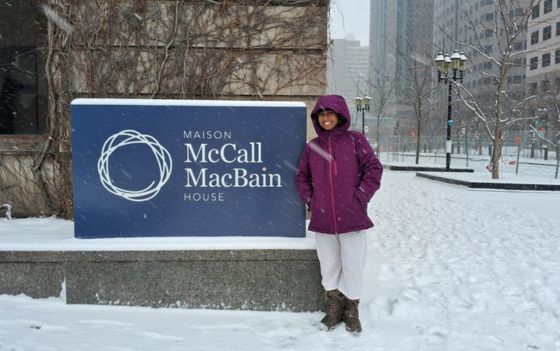
Kiran's story is pure inspiration! Growing up in Kolkata she juggled family and studies. “Having to raise three children wasn’t easy for my parents, but World Vision India supported my education and helped me discover my passion for social issues.” World Vision India’s Snehadeep community project and Play for Peace programme, conducted workshops on life skills, street plays, and puppet shows which became platforms for her to find her voice.