Once Upon a Time in Tonk..
“It would take one hour to walk to reach school. We had to puddle through deep sewage during the rain. Stray dogs also followed us,” says little Seema who lives in a village in Tonk, Rajasthan. These were some of the dangers eight-year-old Seema and her friends faced on the way to school.
Due to lack of teachers, in 2014, the Rajasthan State Government merged a number of primary and secondary schools.
One such merger happened at the Dakhiya School, at Tonk district, Rajasthan in August 2014. The school merged with a larger secondary school that was more than one and a half kilometers away.
"I used to play and go to the fields to graze our goats,” says Seema, during the three months that she had dropped out.

In the survey done with World Vision India, it was seen that out of the 54 students that studied at Dakhiya, only a handful continued going to the merged school.
Seema is currently studying in fourth grade and lives with her 50-year-old grandmother, Badam. Seema’s parents are construction labourers and they live in Jaipur, which is about three hours by bus. “My parents bring clothes and sweets when they come to visit once or twice a month,” says Seema with a smile.
“Seema has been living with me for the past three years now and she is an obedient child. She loves going to school and studying,” says Badam.
Students at Dakhiya School mostly belong to the marginalized tribes along the lines of the Indian caste system. “When the school was closed, a lot of parents’ work got hampered as they would have to drop their children at school walking for about an hour. Most of them were daily wage labourers who had to rush to the cities at dawn,” says 60-year-old Jagdish.
Jagdish is a member of Citizen Voice and Action (CVA), an advocacy tool implemented by World Vision India in 2009. A core team is formed from existing local structures such as the Village Development Council, self-help groups, and community-based organisations. The purpose of the CVA team is to equip community members, establish local leadership, and coordinate groups to come together and fight for the rights they are entitled to.

As of 2015, around 86 CVA core groups and 39 Disabled People’s Organisations are formed across Northern India.
The 11-member CVA core action team in Dakhiya village is established in 2013. They meet once a month to discuss issues related to children’s health and hygiene, education, mid-day meals, and more.
The Dakhiya CVA members were already well versed with the provisions of the Right to Information (RTI) and Right to Education (RTE) Acts.
After the primary school closed, feeling helpless, a lot of parents approached the CVA team. "Four to five parents would come every day, asking the CVA team to help reopen the school," says Jagdish. After detailed discussions with the community, the CVA team met with the principal of the school, who was helpless too.
“I was extremely sad when I heard they were closing down the primary school. Children already face difficulty attending this school. Travelling further for classes is practically impossible,” says 46-year-old Sitaram, headmaster of Dakhiya School.

A written application with the signature of all community members on the need to reopen the primary school was submitted to the District Collector and the Member of Legislative Assembly (MLA). Soon an investigation was probed. The surveyors discovered that the distance from the community to the secondary school was beyond the official standard, which is less than one kilometer.
"Dakhiya is one of the two schools we reopened due to the difficulty in access and distance,” says Ajit Mehta, MLA of Tonk district.
The Primary school at Dakhiya was reopened in November 2014. This led to the re-enrollment of a large number of drop-out children from around the community.
Currently there are 42 children from one to fifth grade enrolled at primary school. Every month, the School Management Committee meets with the parents and discusses the progress of the children in their academics.
“I want to become a teacher and educate my village," says Seema.
Seema eagerly waits for her parents to participate in school meetings when they are around. She understands how vital education is. Due to the lack of education, her parents have to work away from her.
“Now, I’m happy to go to my school nearby,” Seema adds with a smile as she drinks fresh milk before heading to her reopened primary school.
-Daniel Mung/World Vision India
People's needs are always the epicenter of any development activity. As we observe the World Day of Social Justice, this story gently reminds us that all efforts undertaken on the road to development are of the people, by the people and for the people. In a world where governance shapes the future of a nation, tools such as the CVA help the common citizen realize that his opinions count too.
Labels: #advocacy #citizensvoiceandaction #equalrights #featurestory #goodgovernance #socialjustice #featurestory
Kiran's Inspiring Journey to Canada
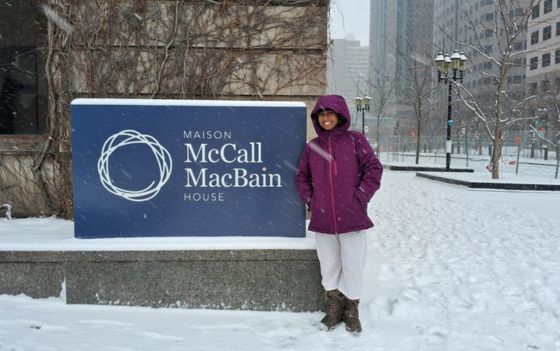
Kiran's story is pure inspiration! Growing up in Kolkata she juggled family and studies. “Having to raise three children wasn’t easy for my parents, but World Vision India supported my education and helped me discover my passion for social issues.” World Vision India’s Snehadeep community project and Play for Peace programme, conducted workshops on life skills, street plays, and puppet shows which became platforms for her to find her voice.