How Women’s Livelihood Programs Through NGOs Are Building Resilient and Sustainable Communities
Imagine waking up one morning and realising that the work you depended on has disappeared.
There is no salary coming in. No savings to fall back on. No certainty about when the next opportunity will arrive.
But the bills have not stopped.
Neither have the needs of your children.
For millions of daily wage earners, small vendors, marginal farmers and informal workers across India, this was the reality during the COVID-19 pandemic. The loss of livelihoods quickly became a crisis of food, housing, healthcare and family wellbeing.
Azim Premji University's research during the pandemic found that about two-thirds of workers surveyed had lost employment, while 49 per cent of households reported that they did not have enough money to buy even a week's worth of essential items. In such moments, support needs to reach people quickly.
But it also needs to give them something equally important: choice.
When Income Disappears
The hardest part of losing an income is not always the first day.
It is what follows.
Rent still needs to be paid. Children still need food. Farmers still need seeds. A shopkeeper still needs stock. A street vendor still needs working capital before they can begin selling again.
For families with savings, a temporary disruption may be manageable.
For families living from one day's earnings to the next, even a short interruption can have serious consequences.
World Vision India responded to these livelihood disruptions through a Cash and Voucher Programme designed to provide timely support to vulnerable families and individuals.
The approach was straightforward: instead of deciding everything a family needed on their behalf, provide support that allowed them to prioritise their own most urgent needs.
This approach is also an important part of the work carried out by impact driven ngos, where humanitarian assistance is designed not only to address immediate hardship but also to help families move towards recovery and resilience.
Giving People the Power to Rebuild
Cash-based assistance has increasingly become an important part of humanitarian response around the world.
The logic is simple.
Families know their circumstances better than anyone else.
A farmer may need seeds. A vendor may need to restock. A small business owner may need to replace equipment. Another family may need to buy food or meet an urgent household expense.
There is no single package that can address all of these needs.
World Vision India's programme therefore reached different groups facing livelihood disruptions, including migrant workers who had returned home, small farmers, landless tenants, daily wage earners and street vendors.
Cash vouchers ranging from ₹1,000 to ₹10,000 were provided based on local needs and market conditions.
For farmers, commodity vouchers helped them access inputs such as seeds, bio-fertilisers and agricultural tools.
For small entrepreneurs, conditional cash support helped restart livelihoods that had been forced to close.
More than 5,381 small entrepreneurs were supported through the initiative.
Each number represents a person trying to reopen a business, return to work or create an income after a period of uncertainty.
Such interventions contribute to sustainable community development by helping vulnerable households strengthen their ability to recover and participate in their local economies.
A Small Shop, A Fresh Start
For Vyga's family in Poonthura, Kerala, that support came at a particularly difficult time.
Her father had stopped fishing following the disruption caused by Cyclone Ockhi. The family also had a petty shop, but without enough money to purchase stock, the business could not provide the income they needed.
Then came a ₹5,000 cash transfer through World Vision India.
The family used it to restock the shop.
It was a modest intervention, but it gave them the means to start earning again.
“With World Vision India's timely support, we have been fortunate to earn money to meet our family's essential needs,” Vyga said.
Her words capture something that can sometimes be missed when we talk about humanitarian assistance.
Support is not only about what is given.
It is also about what people are able to do with it.
For Vyga's family, it meant reopening their shop.
For another family, it might mean buying seeds before the planting season.
For a street vendor, it might mean purchasing stock.
For a daily wage earner, it might mean keeping food on the table until work becomes available again.
Dignity Is Part of Recovery
There is dignity in being able to make those choices for yourself.
That is one of the strengths of cash-based support.
It recognises that people facing hardship are not simply recipients of aid. They are parents, farmers, workers, entrepreneurs and community members who understand what their families need.
When support is timely and flexible, families can use it where it can make the greatest difference.
And the impact can reach children in ways that are not always immediately visible.
A family's ability to earn can mean a child continues going to school. It can mean better food at home. It can mean access to healthcare. It can reduce the pressure to send children into work when household income disappears.
This is where livelihoods and child wellbeing meet. It is also why the work of an NGO for Children in India often extends beyond direct services for children and includes strengthening families and communities around them.
When families have stronger livelihoods, children can have greater opportunities to remain in school, receive nutritious food and access essential healthcare.
From Immediate Relief to Recovery
A cash transfer cannot solve every challenge a family faces.
But at the right moment, it can prevent a difficult situation from becoming a much deeper crisis.
It can give a family breathing space.
It can help a business reopen, a farmer return to cultivation or a parent put food on the table while rebuilding an income.
For thousands of families supported through World Vision India's response, the assistance was one step towards recovery.
This kind of response also complements broader women livelihood programs NGO initiatives, education support, healthcare interventions and community development efforts, because household resilience is closely connected to the wellbeing and opportunities of every family member.
The ultimate goal is not simply to provide short-term assistance. It is to help families regain stability, protect their children's wellbeing and build the confidence to move forward.
And sometimes, one step is what a family needs to begin moving forward again.
For families facing poverty and uncertainty, timely assistance can mean more than financial support. It can protect dignity, preserve livelihoods and create space for recovery.
When a family can decide what it needs most, support becomes more than relief.
It becomes an opportunity.
An opportunity to reopen a shop.
An opportunity to return to work.
An opportunity to feed a family.
An opportunity to keep a child in school.
And, ultimately, an opportunity to rebuild a future with hope.
Kiran's Inspiring Journey to Canada
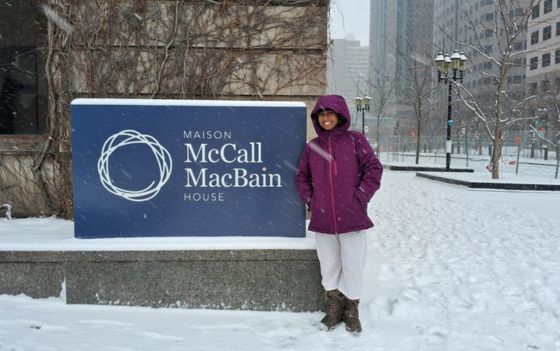
Kiran's story is pure inspiration! Growing up in Kolkata she juggled family and studies. “Having to raise three children wasn’t easy for my parents, but World Vision India supported my education and helped me discover my passion for social issues.” World Vision India’s Snehadeep community project and Play for Peace programme, conducted workshops on life skills, street plays, and puppet shows which became platforms for her to find her voice.